
Distribution Compatibility Is Often Overlooked
Heat pump buyers often focus on equipment efficiency and capacity while assuming heat delivery inside the home will take care of itself. In practice, a heat pump may be properly sized and well installed yet still disappoint if the distribution side of the system is poorly matched to how the equipment delivers heat.
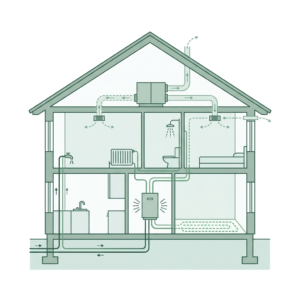
That matters because generating heat and distributing heat are not the same task. Buyers often evaluate the outdoor unit as though it determines system performance alone, while comfort may depend just as much on how heat is emitted, circulated, and controlled once it enters the building.
One common misunderstanding is assuming any heat distribution system compatible with a legacy boiler is automatically compatible with a heat pump. Sometimes it is. Sometimes distribution assumptions quietly shape whether efficiency claims or comfort expectations hold in real use.
Emitter compatibility can be part of that limit. Some emitters designed around hotter boiler temperatures may deliver dramatically different heat output at the lower water temperatures where heat pumps often perform best. A system may technically still operate, yet struggle to deliver expected comfort without larger emitters, different emitter types, or higher operating temperatures that can push the heat pump toward less favorable efficiency.
Distribution compatibility is not only about emitters, but about flow. Heat pumps often depend on water movement as much as water temperature. If legacy pipework, pressure losses, or hydraulic resistance restrict flow, the issue may not be insufficient heat generation but whether the system can transport that heat the way the heat pump expects. Buyers often focus on kilowatts while missing that flow can be a hidden performance bottleneck.
Hydraulic behavior can matter even where components seem individually compatible. Balancing, zoning arrangements, pressure drops, and system volume may influence whether the heat pump operates steadily or under avoidable stress. In some systems, too little active water volume or overly aggressive zoning can leave the heat pump with nowhere to release energy smoothly, pushing stability problems that buyers may misread as equipment weakness.
Control logic often sits inside this problem too. Heat pumps may prefer longer, steadier operating patterns than some legacy control approaches were designed around. Distribution and controls may be technically connected while still conflicting operationally. In some cases, buffering or hydraulic separation may be less an optional add-on than part of making the distribution side compatible.
Mixed systems can introduce further complications. Homes combining radiant floors, radiators, fan coils, or partial retrofits may impose competing temperature expectations on one heat source. A system may not fail because any one emitter is wrong, but because the distribution side is asking one machine to satisfy incompatible thermal behaviors. That is a compatibility problem, not merely a controls tweak.
Distribution responsiveness matters as well. High-mass systems and low-mass systems may respond very differently to modulation and weather-responsive controls. Buyers often treat distribution as passive infrastructure when it can materially shape how the heat pump behaves, how comfort feels, and how efficiently the system operates.
Distribution compatibility can also shape economics, not only comfort. A heat pump pushed toward higher temperatures or unstable flow conditions to satisfy incompatible distribution demands may still heat the house, yet potentially with very different efficiency outcomes than expected. Buyers sometimes assume disappointing operating costs reflect equipment underperformance when distribution compatibility may be part of the story.
This is where stronger buyer questions matter. Ask not only whether the heat pump can meet the load, but whether the distribution system can deliver that heat at the temperatures and flow conditions where the equipment performs best. Ask whether emitters were evaluated for low-temperature output, whether flow constraints or zoning behavior were assessed, and whether buffering or mixing strategies were treated as part of compatibility rather than accessories. Ask where the distribution side may force the heat pump away from its preferred operating behavior. Those questions often reveal whether a proposal is designing an integrated heating system or merely replacing a heat source.
Distribution compatibility is often overlooked not because installers ignore it, but because buyers often focus on heat production while assuming heat delivery will follow automatically. For buyers, the deeper question is not simply whether the heat pump can make enough heat. It is whether the house can absorb, move, and use that heat in the way the heat pump was designed to provide it.