
Pipe Size Limits How Much Water Can Flow
Many water performance complaints get blamed on pressure when the hidden constraint is pipe size. People often assume if supply pressure is strong enough, the system should deliver whatever flow the house demands. But water delivery is not governed by pressure alone. It is also governed by how much water the system can physically move.
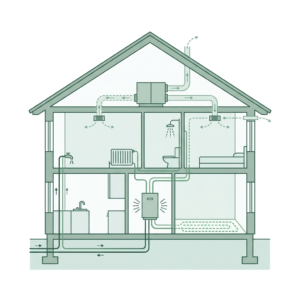
This is where pipe sizing becomes less an installation detail and more a system limit. Pipe diameter does not simply influence performance. It places boundaries on what simultaneous demand the system can support before performance begins to degrade.
This matters because many disappointing systems do not fail because the source pressure is weak. They fail because demand eventually runs into carrying capacity.
A common buyer mistake is treating pipe size as if small differences in diameter imply small differences in outcome. But capacity does not scale as intuitively as many assume. What looks like a modest increase in pipe size can produce disproportionately large differences in how much water the system can comfortably carry.
That is why bottlenecks often hide in plain sight. Buyers may focus on pressure at the source while the real constraint sits in the width of the pathway itself. This is also where flow physics gets misunderstood. When demand is pushed through constrained piping, velocity may rise, resistance can rise with it, and more of the system’s energy can be spent overcoming friction rather than delivering usable flow where it matters.
Some systems then create a false impression of performance. Water may feel aggressive at a fixture while the system is actually struggling through turbulence, noise, or stress rather than delivering stable volume gracefully.
Many recurring complaints quietly point to this:
“The shower weakens when another tap opens.”
“Two bathrooms together feel unstable.”
“I added pressure but flow still feels limited.”
These often sound like pressure complaints. They are frequently capacity complaints.
This is where boosting pressure often gets misunderstood. More force can sometimes push symptoms around without removing the bottleneck. If the limiting factor is how much water the system can carry, adding pressure may intensify stress while leaving the deeper limit untouched.
Pipe size also interacts with distance, branch count, and simultaneous use. A diameter that feels adequate under isolated use can reveal limits once the house behaves like a whole system rather than a single fixture.
Modern demand patterns expose this more often than buyers realize. Plumbing assumptions built for older usage patterns may struggle when layered with today’s simultaneous appliances, higher-flow fixtures, and stacked expectations.
This is why many water upgrades disappoint. Buyers often focus on pumps, regulators or incoming pressure before asking whether the plumbing backbone can physically support the performance they expect.
Another blind spot is assuming capacity problems only show up in large homes. They can appear in modest houses too, especially where newer expectations exceed what older piping assumptions anticipated.
There is also a misconception that if water comes out fast, capacity must be fine. Single-fixture performance can hide bottlenecks. True system capacity often reveals itself only under concurrent demand.
This is where pipe sizing becomes a design question, not just a plumbing specification. It shapes whether demand can be shared gracefully or turns into competition.
A more protective question is not simply whether pressure is high enough, but whether the pipe network can carry the flow your real usage patterns ask of it.
That often reveals more than pressure measurements do.
Buyers who miss this sometimes keep treating symptoms. They change fixtures, add boosters, replace regulators, while the deeper limit sits untouched inside the distribution path.
PreciseBuyer treats this as a hidden capacity problem buyers often mistake for weak supply.
Because many water systems do not disappoint because pressure was too low.
They disappoint because the pathway was too small for the demand placed on it.
Good pressure cannot fully compensate for a constrained path. And many expensive fixes begin when buyers confuse force with capacity.