
Simultaneous Use Causes Pressure Drops
Many buyers assume water pressure problems appear only when the supply itself is weak. If fixtures work well one at a time, the instinct is often to assume the system has enough pressure. What often gets missed is that pressure complaints often emerge not under single-fixture conditions, but when simultaneous demand exposes how the system behaves under shared load.
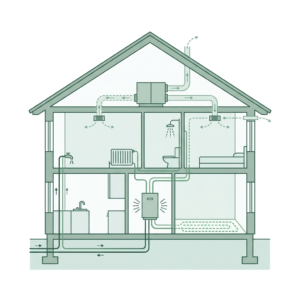
This is where many expectation gaps begin. A system can appear perfectly adequate during isolated use while struggling once showers, faucets, appliances, or irrigation zones begin drawing at the same time.
This is because pressure problems under simultaneous use are often not only supply-pressure problems. They can be flow allocation problems.
Available pressure and available flow are often misunderstood as the same thing. They are related, but not identical. Many frustrating pressure complaints are really shared-demand performance limits showing up as pressure symptoms.
This is where static and dynamic pressure often get confused. A home may show strong pressure when no water is moving, yet behave very differently under load. What often matters in ownership is not static pressure, but how much pressure survives once multiple fixtures begin drawing simultaneously.
That distinction often exposes why systems that seem strong on paper can feel weak in use.
Pipe sizing is often part of that story. Under overlapping demand, small distribution lines can force water velocity higher, increase friction losses, and produce pressure collapse that does not appear during isolated fixture use.
This is the narrow straw effect many buyers never realize they are living with. The issue may not be insufficient incoming pressure, but a distribution system being asked to share more flow than its geometry supports gracefully.
This is why two bathrooms operating together may reveal problems invisible during single-fixture testing. Pipe sizing, friction losses, pressure drop across valves, regulator behavior, branch distribution, and pump response can all begin interacting once concurrent loads stack up.
This is where recurring complaints like the shower drops when someone opens a tap often come from. And sometimes what changes is not only pressure but temperature stability.
Pressure-balancing or thermostatic valves can add another misunderstood layer. In some systems the apparent pressure drop a user feels may partly be a protection response, where the valve reduces flow to protect temperature safety as supply conditions shift.
That means what feels like weak pressure can sometimes be the system trying to prevent a scalding event.
Water heating capacity can introduce another hidden limit. Some simultaneous-use complaints blamed on pressure can actually be hot water production limits showing up as reduced usable flow under shared demand.
A common buyer mistake is assuming stronger supply pressure alone solves this. In many systems the real issue is how demand is distributed when loads overlap.
The more revealing question is often not whether pressure feels strong at one fixture, but how the system behaves when multiple fixtures ask for water at the same time.
That often reveals more than static pressure readings alone.