
System Limits Often Cause Pressure Loss
Buyers often treat poor water pressure as though something is “stealing pressure” somewhere in the system. In practice, some pressure problems are less about mysterious losses and more about hard system limits being reached. The system may not be malfunctioning so much as operating at the edge of what its infrastructure can deliver.
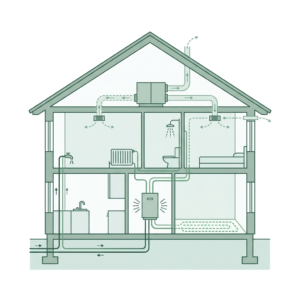
That matters because pressure performance can be shaped by limits buyers rarely evaluate directly. Service line size, meter capacity, pipe diameter, elevation changes, regulators, branch geometry, fixture demand, and supply constraints may all define performance ceilings no booster or fixture upgrade can easily overcome.
One misunderstanding is assuming weak pressure means something has degraded. Sometimes it has. Sometimes the system may simply be encountering a capacity limit that was always there but only becomes obvious under current usage expectations. What feels like a failure may sometimes be the system revealing its design boundary.
Supply-side limits can matter. Municipal service capacity, well yield, pressure tank behavior, service line restrictions, or undersized meters may cap what the property can receive before internal distribution even enters the picture. A booster may increase pressure downstream, but it may not create upstream supply capacity the service line or meter cannot deliver. Buyers often pursue in-home solutions for problems originating before water reaches the house.
Elevation can impose limits too. Water pressure does not arrive at upper floors unchanged. Vertical lift itself consumes usable pressure, which means what appears adequate at entry may behave very differently at the highest fixture. In some homes, apparent pressure problems may partly be gravity math rather than failing plumbing.
Infrastructure limits inside the property can matter as well. Pipe sizing, long runs, stacked fixtures, elevation head loss, legacy layouts, and shared branches can create pressure behavior that reflects capacity ceilings rather than isolated faults. In those cases pressure may not be “leaking away,” but being consumed by system constraints.
Simultaneous demand often exposes these limits. A home may seem adequate under isolated use yet struggle once multiple loads overlap. Sometimes the system did not deteriorate at all, the demand profile simply grew beyond what the original infrastructure was built to support. Added bathrooms, irrigation, filtration devices, larger fixtures, or changing occupancy can reveal limits that were always latent.
This matters because buyers may respond to limit problems with localized fixes that do not change the limit itself. Replacing fixtures, adding pumps, or adjusting regulators may improve symptoms while leaving the underlying capacity constraint largely untouched. There is a difference between pushing harder against a limit and increasing the limit itself.
That distinction matters in solutions too. Some remedies attempt to force more performance from the same infrastructure. Others change capacity through different architecture, whether by addressing supply constraints, changing distribution capacity, or managing demand differently. Buyers often compare products before asking which kind of problem they actually have.
This is where stronger buyer questions matter. Ask whether the observed pressure problem reflects a fault or a system capacity ceiling. Ask whether service entry, meter capacity, elevation losses, and simultaneous demand were evaluated before localized remedies were proposed. Ask whether demand has outgrown original infrastructure assumptions. Ask whether the proposed solution increases capacity, or merely pushes harder against a bottleneck. Those questions often reveal whether a proposal is solving a problem or negotiating with a constraint.
System limits often cause pressure loss not because something is necessarily broken, but because water systems can reach boundaries buyers mistake for malfunctions. For buyers, the deeper question is not simply where pressure is being lost. It is where the system may have reached its limit.