
Not All Homes Suit Low-Temperature Heating
Heat pumps are often described as efficient heating systems, but that efficiency depends heavily on the type of home they operate in. Unlike traditional high temperature systems, heat pumps are designed to deliver lower water temperatures over longer periods. This changes what “adequate heating” actually requires from the building itself.
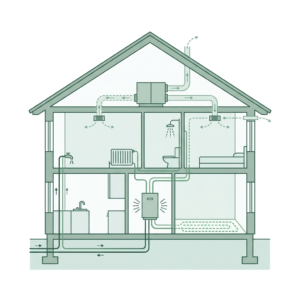
Where conventional boilers typically circulate water at around 70–75°C, heat pumps operate most efficiently between roughly 35–55°C. This means the system is not designed to produce intense, short bursts of heat, but to maintain a steady thermal balance over time. As a result, the building itself becomes part of the heating system.
In homes with good insulation and high thermal mass, such as well-built masonry or concrete structures, this approach works as intended. Heat is absorbed, retained, and released gradually, allowing lower temperatures to maintain consistent comfort. The system runs longer, but more efficiently, and indoor conditions remain stable.
In less suitable buildings, the same principle creates a mismatch. Heat escapes faster than it can be delivered, especially through poorly insulated walls, windows, or roof structures. Even with continuous operation, the system may struggle to raise or maintain indoor temperatures. This is often interpreted as underperformance, but it is typically a result of the building losing heat faster than the system can supply it.
Heat distribution adds another layer to this dependency. Low-temperature systems rely on larger heat-emitting surfaces, such as underfloor heating or appropriately sized radiators to transfer energy into the space. When existing radiators are designed for higher temperatures, their effective output can drop significantly at lower temperatures. The system may be producing heat, but it is not being released into the room at the required rate.
This is why suitability cannot be judged by system specifications alone. A proper assessment starts with understanding how much heat the building loses, room by room, under real conditions. Without this, the system may be correctly installed but incorrectly matched to the environment it operates in.
These conditions do not indicate a fault. They reflect a structural relationship: the performance of a heat pump is defined as much by the building as by the system itself. When expectations are based on how previous systems behaved fast response, high temperatures, short cycles—the difference can feel like a limitation. In reality, it is a shift in how heating works.