
System Layout Affects Pressure Distribution
Pressure problems are often blamed on supply strength when the real issue is how the system distributes water once it enters the house. People assume pressure should behave equally everywhere, but plumbing layouts rarely divide demand evenly. The same incoming supply can feel stable in one part of the home and weak in another simply because the system routes water through very different paths.
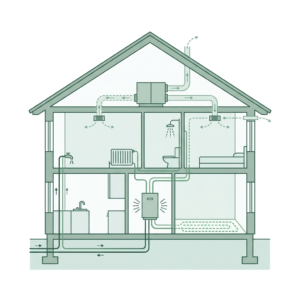
This is where layout becomes performance. Every branch, elevation change, manifold decision, long pipe run, tee fitting, reduction, and fixture grouping shapes how pressure is experienced under load. What looks like a source problem is often a distribution problem created after the meter.
This matters because pressure does not simply travel through a house unchanged. It is spent, redirected, restricted, and sometimes unintentionally starved. A second-floor shower, a distant garden tap, and a kitchen branch near the main line may not be drawing from the same practical reality, even when they share the same supply.
Elevation is one place this gets misunderstood. Buyers often interpret weaker performance at upper fixtures as supply weakness, when part of what they are seeing may simply be pressure already consumed by vertical lift before demand even begins. Some systems are fighting geometry before they are fighting load.
Branching logic often creates another layer of distortion. Some layouts unintentionally privilege certain fixtures while leaving others at the end of long resistance-heavy routes. Pressure may not be failing everywhere. It may simply be distributed unevenly.
This is where layout architecture matters more than many assume. Traditional branched systems can make fixtures compete through shared pathways, while more balanced manifold-style approaches can isolate demand and reduce those conflicts. Many users experience “pressure problems” that are partly distribution architecture problems.
Collectors and manifolds are often misunderstood in the same way. People focus on whether they exist, not how they are configured. But balancing decisions inside those layouts can affect whether the system behaves predictably or turns into competing branches fighting each other.
There is also a blind spot around velocity. Some systems may appear to maintain performance only by forcing water through constrained paths in ways that increase noise, turbulence, or mechanical stress. Buyers sometimes mistake aggressive behavior for strong design.
This is where many pressure upgrades go wrong. People add booster pumps or larger equipment before asking whether the underlying distribution logic is sound. That can increase force at entry while leaving imbalance untouched, or even intensify stresses the layout already struggled with.
Hydraulic balance often sits behind complaints users describe as random. Irrigation loads, clustered bathroom demand, or dominant branches can sometimes pull performance away from weaker parts of the system. What looks inconsistent may simply be an unbalanced distribution network revealing itself under simultaneous demand.
Recurring field complaints often sound deceptively simple:
“The guest bath is always weaker.”
“Pressure dies only when irrigation runs.”
“The upstairs shower works, until someone opens a tap.”
These often sound unrelated. They are frequently layout stories.
The more protective question is not whether the house has enough pressure, but whether the plumbing layout allows that pressure to arrive where demand appears, when demand appears. That often reveals more than static pressure readings do.
A more diagnostic buyer asks harder questions:
Where are the longest runs?
Where are the highest fixtures?
Which branches dominate flow when multiple loads appear?
Where might pressure loss be concentrating before the symptom shows up?
Those questions often expose system logic more clearly than product upgrades do.
Another blind spot is assuming plumbing layout is just installation detail. It is often treated as contractor execution after product selection is done. But layout can shape outcomes as much as pumps, regulators, or supply upgrades.
And this is where wrong assumptions create expensive detours. People often buy correction hardware for what is really distribution geometry.
Good pressure can be poorly delivered.
Moderate pressure can be intelligently distributed.
Those are not the same system.
The strongest systems often do not feel powerful because they are over-pressurized. They feel stable because layout keeps demand from collapsing into conflict. That distinction protects buyers.
Because when water performance disappoints, the wrong product is often blamed before the wrong system logic is examined.
Good pressure may be produced at the source.
Great performance is often decided in the path.