
How Solar Systems Perform
Across Changing Conditions

The system may look right on paper. But real-world performance takes shape through how production, usage, and system behavior interact day after day, season after season.

Home › Systems › Solar Panels › Real-world behavior

Solar decisions are often framed as technical and financial calculations, where correct sizing, good equipment, and available incentives are expected to produce predictable outcomes. That assumption ignores how these systems actually unfold after installation. Once deployed, a solar system becomes entangled with regulations, financial structures, installation quality, and long-term service realities that continue shaping its performance over time.

When this layer is overlooked, decisions that appear solid at the beginning begin to drift. Systems that are technically correct become delayed, financially heavier than expected, difficult to activate, or harder to maintain than anticipated. The issue is not that the system fails, but that the decision was made as if installation marked the end. In reality, installation is the point where real-world constraints start defining the outcome.

Standards & Regulations: When Operable Isn’t Approvable
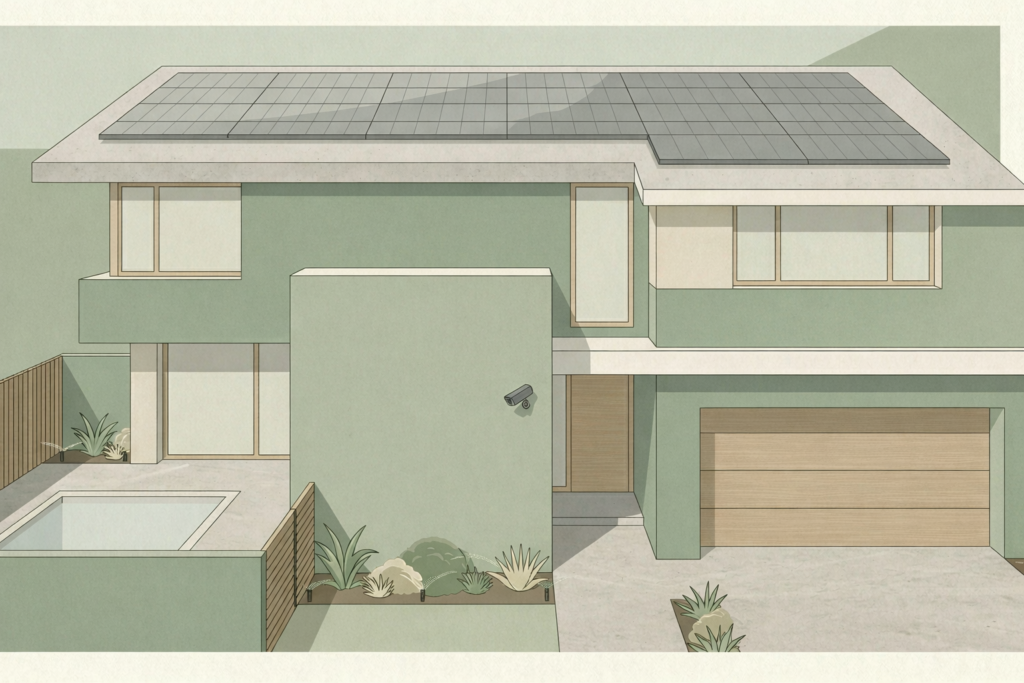
A solar system can be technically valid and still fail to materialize as expected because permission operates independently from performance. Electrical codes, fire safety rules, utility limits, and permitting processes define what can actually be installed and activated. When these constraints are treated as secondary, projects are redesigned, delayed, or reduced after key decisions are already made. The system does not become wrong, but the context around it changes, reshaping outcomes in ways that were never visible at the start.

When “possible” meets “permitted”
Residential solar systems are rarely constrained by physics first. They are constrained by rules. Most homeowners encounter this only after the design looks finished, the equipment is chosen, and the installation feels imminent. On paper, the system works. On the roof, it fits. In simulations, it produces exactly what was promised. And yet, the project slows down, shrinks, or stops—not because the system is wrong, but because it crosses an invisible boundary set by standards, codes, utilities, or permitting authorities.

This is where many decisions quietly change direction. At a technical level, residential PV systems are expected to comply with a web of electrical, fire, and safety standards. These rules are not optional, and they are not interpreted uniformly. Electrical codes define how DC and AC wiring must be routed, labeled, grounded, and protected, while fire access requirements dictate where panels may and may not be placed on a roof, regardless of available space or optimal orientation. Rapid shutdown requirements shape inverter choice and system architecture in ways that are rarely discussed during early sales conversations.

When compliance reshapes the design
None of these constraints are controversial. What is often overlooked is that they do not merely “validate” a design after the fact—they actively shape what is designable in the first place. Homeowners often report, “Installer said it would fit, but fire code setback required rearrangement,” or “Our inverter had to be downgraded due to utility export caps,” highlighting that technical compliance can force unexpected design changes even after selection.

Beyond technical standards, non-technical regulations impose equally powerful limits. Local permitting processes, utility interconnection rules, inspection workflows, and net metering policies determine whether a system that is technically sound can actually operate. A homeowner may be told that a certain system size is ideal, only to later learn that the utility caps export capacity, requires transformer upgrades, or enforces percentage-based limits tied to historical consumption. Users frequently describe waiting for approvals with comments like, “We were told it would take 2 weeks, permit took 6 weeks,” or “Fire department inspection required multiple site visits,” showing the practical time and process uncertainties that sales narratives rarely convey.

When the process becomes the constraint
At that point, the decision is no longer about efficiency or payback—it becomes a negotiation with infrastructure. Sales narratives tend to compress this complexity into reassuring phrases such as “We handle the permits,” “The system is code-compliant,” or “Interconnection is standard.” What these phrases quietly assume is that standards are static, interpretations are consistent, and timelines are predictable. In practice, none of these assumptions reliably hold.

The result is a recurring pattern: systems are redesigned not because homeowners changed their minds, but because an external authority introduced a constraint that was invisible at the moment of choice. Panel layouts are altered to satisfy fire setbacks, inverter capacities are reduced to meet utility rules, and installation dates slip while permits circulate between departments that do not share urgency—or accountability. Homeowners share experiences such as, “Design changes due to fire code left us frustrated,” and “System ready but couldn’t turn on for months,” illustrating the psychological stress and cumulative delays caused by standards and regulatory processes.

When reality replaces assumptions
Months later, homeowners do not talk about voltage ranges or code sections. They talk about waiting, about approvals, and about systems that were “ready” but could not be turned on. They talk about discovering that compliance is not a checkbox, but a process with its own logic, incentives, and delays. This is the core misunderstanding: standards and regulations do not simply govern how a solar system must be built—they govern whether, when, and to what extent it may exist in the real world.
A residential solar decision that ignores this layer is not incomplete—it is structurally fragile. Not because the technology fails, but because the system was designed for possibility, not permission. Understanding this does not require memorizing codes or tracking local ordinances. It requires recognizing that every technical choice is embedded in a regulatory environment, and that environment has the power to reshape outcomes long after the contract is signed.

Where the decision actually shifts
The moment this becomes clear, the decision shifts. It stops being about selecting equipment—and starts being about navigating constraints. That shift is not a detail. It is the difference between a system that exists in theory and one that survives contact with reality. In summary, homeowners’ real-world experiences confirm that standards and regulations actively shape project outcomes: delays, redesigns, and forced compromises are normal, and technical feasibility alone does not guarantee installation or operation.

Incentives & Financing: When the Decision Shifts

Financial incentives are often perceived as simplifying the decision, but they frequently introduce a different layer of complexity. Instead of evaluating whether the system fits the home, buyers begin optimizing around rebates, deadlines, and financing structures. This shifts the decision from technical suitability to financial timing. Over time, hidden costs, interest burdens, and changing policies reveal that incentives do not improve the system itself. They reshape the decision logic that led to it.

When incentives don’t mean what they seem
Homeowners frequently encounter misleading information regarding government support and financing options for solar energy systems. Users emphasize that incentives are often insufficient to reduce their financial burden, with comments such as:
“I thought these incentives made solar basically free — they don’t.”
“They said rebates would cover it… end up with a huge monthly payment.”
In Canada, some federal programs have ended or changed, leaving middle-income homeowners without adequate support and preventing the projected savings from materializing. Sales representatives often highlight time-limited offers, tax credits, and rebates as sources of savings; however, these claims frequently obscure critical details, such as the fact that tax credits only reduce tax liability and may not provide cash value, or that eligibility varies by region.

When financial framing hides real costs
Salespeople also use phrases like “net system cost after incentives” to present benefits based on tax deductions rather than actual cash flow, which can be misleading for homeowners. In Ontario, some rebate programs exclude net metering, reducing what initially appears to be a valuable financial incentive. As a result, homeowners consistently discover that incentives are not uniformly available across regions or at the time of installation.
Many homeowners also find that financing combined with incentives does not produce substantial savings. Comments like:
“After rebates and financing, my loan payments still feel huge.”
“Free solar offers just turned into a loan that I’m paying for years.”
highlight the complexity of financial structures and the often unexpectedly high monthly payments. Users also report that high interest rates and additional dealer fees significantly increase the total cost, reducing expected savings.

When urgency reshapes the decision
Incentives and tax benefits can create pressure to make hasty decisions, with users stating:
“Incentive deadline forced us to rush into a loan we now regret.”
This dynamic shifts the decision-making process from selecting a product or evaluating technical suitability to managing timing, financial psychology, and uncertainty. Expiring incentives and changing program rules force homeowners to postpone or cancel plans. For example, the discontinuation of Canada’s Greener Homes Loan left many project owners unable to access the expected incentive, sometimes forcing project cancellations.

Early-stage research may suggest straightforward savings such as a 30% federal tax credit combined with government rebates, but post-quote tax burdens, maximum limits, and interest rates often make long-term financial outcomes uncertain.

When projections change over time
Over time, changes in net metering or other policy adjustments affect the initially projected payback period. Users confirm this reality with experiences like:
“Apparently my tax situation means I get zero credit — they never told me that.”
demonstrating the discrepancy between simplified sales narratives and actual outcomes. From a time-layered awareness perspective, incentives may appear simple and advantageous at the early research stage, but post-quote tax and limit issues, monthly payment burdens during financing, and long-term policy changes interact to shape the true financial reality.
Ultimately, government support and incentives, if not fully understood, can impose both financial and psychological stress on homeowners. Field data and user experiences clearly highlight the importance of recognizing these risks early in the decision-making process.

Installation Reality: Running Doesn’t Mean Right

Installation is often perceived as completion, but it is where assumptions are physically locked into place. Choices related to mounting, electrical integration, and layout rarely appear critical in the moment, yet they define long-term system behavior and risk. When these decisions are made without visibility, systems that initially appear correct can develop structural, electrical, or usability issues over time. The system continues to operate, but the consequences of early shortcuts emerge gradually through real-world use.

Installation Feels Like Completion — But It’s the Beginning
Installation is the most misleading milestone in heat pump projects. For many users, the moment the system is switched on feels like the finish line. Field experience shows the opposite: this is often where long-term problems quietly begin. A recurring phrase in complaints is, “At first, everything seemed fine.” This sentence rarely signals satisfaction. More often, it marks the start of a delayed realization.
This delayed realization mirrors how performance claims are experienced in real life. As one user puts it: “The product did not hold up and wore out much faster than expected.” What was framed as “built to last” is only truly tested after installation, through time, stress, and daily use — exactly where catalogs stop speaking.

Trust Replaces Understanding — Then Breaks Later
During installation, trust is frequently established through confidence rather than clarity. Installers commonly say things like, “We’ve done this many times,” or “You don’t need to get into these details—we’ll handle it.” While reassuring at the moment, these statements often resurface months later as regret. Users then say, “We didn’t know these choices mattered,” or “Nobody explained that this would affect comfort.” When the user is excluded from understanding the system, critical decisions are made without accountability.
This same trust gap appears later in support interactions. Warranty and service are presented as reassurance, but in practice they become another system interaction — one that can either restore trust or permanently break it. Field voices describe this clearly: “I sent it in for warranty and got the same damaged product back.” The issue is no longer the component, but the process surrounding it.

Shortcuts During Installation Become Long-Term Problems
Real installations are not clean, controlled processes like those implied in catalogs. Statements such as “These are technical details; no need to worry” often translate into practical shortcuts: existing pipe routes are reused without reconsideration, balancing is done approximately, sensors are placed where access is easiest rather than where measurement is meaningful. Field complaints like “We later realized some things were wrong from the start” point directly to these moments. These are not device failures—they are implementation decisions labeled as “details.”
When these early decisions later collide with performance expectations, users experience the mismatch as broken promises. “Built to last” or “trusted quality” loses meaning when wear, imbalance, or malfunction appears early and the resolution process adds friction instead of relief.

Systems Work — But Never Feel Right
Most installation teams focus on one objective: getting the system operational. Months later, users describe a different reality. “It heats, but it constantly needs adjustment,” “Some rooms always lag behind,” or “Service visits don’t change anything.” These statements indicate systems that technically function but were never properly implemented. Heat pump systems are low-tolerance systems; small deviations during installation grow into persistent comfort issues over time.
At this stage, customer perception quietly shifts. As one user describes it: “Customer service was unhelpful and kept repeating scripted responses.” Once support feels procedural rather than responsive, the internal decision often moves from “fix this” to “never again.”

The Building Is Ignored — Then Blamed
Another recurring field pattern is the building itself being treated as secondary. Phrases like “This is how the existing piping was” or “It works this way too” gradually turn into “Maybe this house just isn’t suitable.” In many cases, the house is not the problem. The problem is that its physical realities—pipe lengths, elevation differences, valve placement, façade exposure—were never translated into system logic. When these factors are dismissed as minor, system behavior becomes unpredictable.

After Installation, Responsibility Disappears
Many users also describe a sense of abandonment after installation. “After the system was installed, nobody came back,” is a common complaint. Heat pump systems reveal their true behavior during the first full heating season. However, when installers assume “everything is already set,” real usage data is ignored. Over time, users compensate by constantly adjusting settings or reverting to old habits, mistaking systemic imbalance for personal error.
This is often the point where warranty and support expectations fully collapse. Users report experiences such as: “The warranty process cost me time and money and solved nothing.” What was supposed to act as a safety net instead amplifies frustration and confirms the feeling that responsibility has been quietly transferred to the user.

Users Adapt — Because the System Was Never Explained
A final silent assumption emerges around user behavior. Field phrases such as “We use it like our old system, and it doesn’t respond well” show how poorly system logic is communicated. Without explanation of operating principles and usage patterns, installations leave behind systems that technically work but feel unreliable. This frustration does not stem from the device—it stems from an implementation process that closed communication instead of opening it.
Once this trust erosion sets in, the decision threshold is crossed. Users articulate it simply: “After this experience, I won’t buy from this brand again.” The issue is no longer the installation detail, but the credibility of the entire system surrounding the product.

The System Was Running — But Wrong From Day One
The field reality is clear: installation is not a mechanical task. It is a chain of decisions that defines the system’s future. Most long-term heat pump problems originate not from what was installed, but from what was decided—quietly, quickly, and without the user’s understanding. A system can run from day one and still be fundamentally wrong. In those cases, failure is not immediate—it is only delayed.

Long-Term Ownership: The Cost That Shows Later

The real cost of a solar system does not appear at purchase, but accumulates through maintenance, service access, performance changes, and long-term dependency. Over time, the system shifts from a one-time decision into an ongoing responsibility. When support weakens, performance declines become unclear, or exit becomes difficult, ownership turns into a sustained burden. The system may still function, but the experience of living with it changes as hidden assumptions surface across years of use.

When Long-Term Costs Start to Surface
Solar systems rarely reveal their true cost at the moment of purchase. What looks like a clear financial decision at the beginning gradually turns into a long-term ownership experience shaped by small, cumulative frictions. Over time, the system shifts from a product you bought into something you have to live with, maintain, and interpret.

How Early Stability Turns Into Ongoing Responsibility
For many users, the first years pass without visible issues. Production seems steady, alerts are rare, and bills appear lower. This creates a sense of confirmation: “It worked fine for the first few years.” But repeated field experience shows this phase is often temporary. It’s not that the system is stable — it’s that problems haven’t surfaced yet.

As time progresses, overlooked aspects of ownership become visible: inverter failures, connection issues, software updates, monitoring disruptions. Warranty assumptions often break at this stage: “Yes, the part was under warranty — the labor wasn’t.” Delays in service add another layer, with appointments scheduled months out, turning “low maintenance” into dependency on availability.
The system’s reliability begins to depend less on hardware and more on access to service. Users face questions they hadn’t considered: Is the installer still operating? Can someone else service this system? Field statements repeat the same pattern: “The installer is no longer in business.” or “No one wants to touch it.” Even when the system continues to run, the absence of responsibility creates a sense of being left alone.

When Performance Becomes Unclear — Not Just Lower
Over time, production drops may appear — but without clear interpretation. Users enter a gray zone: “It’s still working, just not like before.” or “No one can tell me if this drop is normal.” The system hasn’t failed, but expectations quietly erode. The problem shifts from performance itself to understanding what that performance means.

A second layer emerges when economic life diverges from technical operation. The system may still produce electricity, but repair costs begin to outweigh the benefit. The question changes from “How much does it produce?” to “Is it worth continuing to spend money on this?” This threshold is rarely imagined at the time of purchase.

When Ownership Turns Into Friction
As small issues accumulate, many users begin to disengage. Monitoring, troubleshooting, and decision-making become burdens rather than responsibilities: “I just don’t want to deal with it anymore.” The system is no longer actively managed — it is passively tolerated as long as it continues to run.

At the same time, new types of costs begin to appear. Monitoring platforms assumed to be free may shift to subscription models: “I’m paying just to see my own data.” Individually small, these changes reshape how ownership is perceived.

The exit phase introduces another layer of friction. Second-hand markets are limited, and removal costs are rarely considered: “Nobody wants used panels.” What once felt like an asset can begin to feel like a burden.

This becomes even more visible during home sales. Buyers may avoid taking over contracts or hesitate due to uncertainty: “The buyer didn’t want to assume the solar contract.” In some cases, the system complicates the sale rather than supporting it.

What actually shapes performance

The inverter capacity may be “sufficient,” but its operating range may not suit your household. An inverter that is technically well-sized can still operate inefficiently during low-production hours in the morning and evening. Annual production charts tend to hide this; the homeowner is left with the feeling that “the system exists, but it doesn’t produce as much as I expected.”

Production estimates assume the behavior of the roof, not the reality of the home. Simulations usually treat real-world shading patterns, soiling, and temperature effects throughout the year as “average.” The system delivers what was promised; but the lived reality of the house does not fully match the chart.
