
How Solar Systems Work
Beyond the Proposal
Performance doesn’t come from panels alone. It depends on how production, timing, system design, and household usage interact over time. When these elements align, the system delivers as expected; when they don’t, results can feel very different from what was projected.
Solar systems are often sized and configured as if production alone determines success. Panel capacity, system size, and annual output estimates are treated as reliable performance indicators. That assumption misses how these systems actually behave. Solar does not operate as a static production unit. It functions as part of a dynamic system shaped by timing, consumption patterns, component interaction, and changing conditions over time.
When this system logic is ignored, technically correct designs lead to unstable outcomes. A system can generate the expected energy and still fail to meet expectations because that energy arrives at the wrong time, moves through constrained components, or depends on assumptions that no longer hold. The issue is not incorrect calculation, but incomplete framing. Solar performance is not defined by how much is produced, but by how well the system fits the way the home actually lives.
What technical specs actually mean in real life
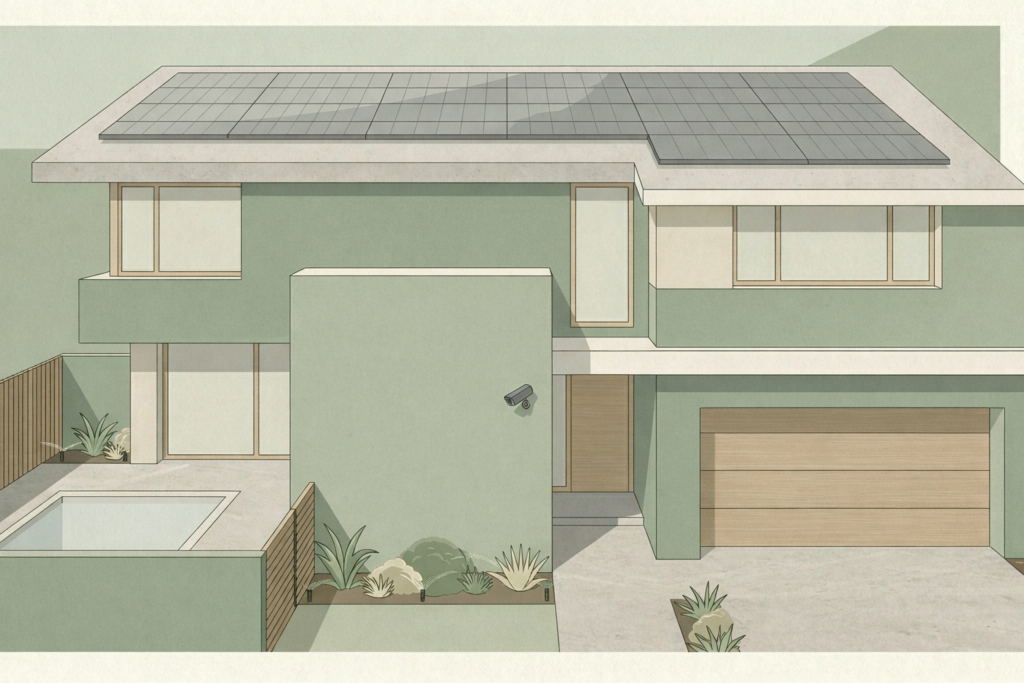
Solar terminology creates the illusion of clarity while quietly shaping incorrect expectations. Concepts like kW, kWh, production, and system size are often understood in isolation, without being tied to real outcomes such as bill reduction or usable energy. When this connection is missing, buyers believe they understand the system while operating with an incomplete mental model. The result is not confusion at the beginning, but disappointment later, when technically correct values fail to produce the expected real-world effect.
System Perspective: What Actually Drives Outcomes
A solar system does not fail as a single component. It underperforms when the relationships between its parts are not aligned. Panels, inverters, batteries, grid connection, and software layers operate as a chain, not as independent elements. When this chain is evaluated in fragments, systems that appear correct at installation gradually reveal instability over time. The system continues to run, but the burden of maintaining balance shifts to the user instead of remaining within the design itself.
Scale, Capacity & Compatibility: Limits of “On Paper”
Sizing a solar system is often presented as a calculation, but in practice it is a decision about trade-offs. A system that is too small requires behavioral adaptation, while a system that is too large introduces economic and psychological friction. The real issue is not size itself, but how well that size fits the household’s actual and evolving usage. When capacity is based on simplified assumptions, the system may function technically while failing to support the way the home actually consumes energy.
Where to next
What most homeowners misunderstand
With the same panels and inverter, there can be more than one “correct” installation but the fastest option is usually chosen.
In most homes, string layout is designed around installation convenience. This is not noticeable on day one; but when shading appears later or a single panel weakens, the performance of the entire string drops together.
The inverter capacity may be “sufficient,” but its operating range may not suit your household. During low-production hours, systems can run inefficiently even if annual production looks acceptable on paper.
Production estimates assume the behavior of the roof, not the reality of the home. Real-world shading, temperature, and usage patterns rarely match the “average” conditions used in simulations.