
Misreading Pressure Problems
Before looking for solutions, understand what pressure actually reflects and what it doesn’t.
Most pressure-related decisions start from what you feel at the tap. Weak flow, inconsistent temperature, or sudden drops are quickly labeled as “low pressure.”
But pressure is only one part of how water moves through a home. In many cases, the issue isn’t force; it’s how water is supplied, shared, and restricted across the system. Looking at pressure alone can lead you toward the wrong fix. Before choosing a solution, it’s worth understanding what’s actually shaping the experience.
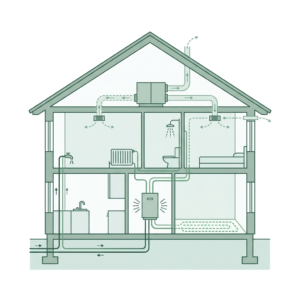
Most homeowners approach low water pressure as a simple deficiency that can be corrected by adding a booster pump. That assumption is misleading. Water pressure in a home is not a single value that can be increased in isolation. It is the result of how supply conditions, plumbing layout, fixture demand, and timing interact across the entire system.
When pressure is treated as a standalone problem, solutions are chosen based on output rather than context. This leads to a recurring pattern where pumps run, systems operate, yet daily experience does not improve. The issue is not that the equipment fails, but that the problem was framed too narrowly. Water pressure only becomes predictable when it is understood as a system behavior, not a number to be increased.
Who is this for and who it isn’t

This is not for someone looking to confirm that a stronger pump will solve the problem, but for someone who senses that the situation is less straightforward than it appears. The common mistake is assuming that low pressure has a single cause and a direct fix. In reality, the same symptom can emerge from different underlying conditions, and treating it as a simple upgrade often leads to repeated frustration rather than resolution.
How water pressure behaves in real use
Water pressure booster systems are rarely misunderstood as products. They are misunderstood in terms of what they actually solve. These systems do not guarantee consistent pressure across all conditions. Their effectiveness depends on how demand, timing, and system constraints interact in daily use. When this is overlooked, installations that appear successful in isolation fail to deliver stable comfort in real-life scenarios.
When the system works — but the pressure still feels wrong
Most dissatisfaction with water pressure systems does not come from defective equipment, but from expectations built on incomplete assumptions. A pump can operate exactly as intended while still producing unstable or insufficient pressure under real household demand. This gap emerges when system limitations are interpreted as product failure, leading to repeated adjustments or replacements that never address the underlying issue.
Where homeowner expectations go wrong
Low pressure feels like a clear problem with a direct fix
The system is simplified before it is fully understood.
“My house is pretty standard”
What seems typical in conversation often behaves very differently in practice.
“If the pump runs, it should be working”
System activity is mistaken for actual improvement.
“It worked at first, so it should keep working”
Early results are taken as proof of long-term stability.