
Before You Commit
Be Clear on What You’re Choosing

At this stage, the question is no longer how the system works. It’s whether you’re ready to live with how it performs across different seasons, under changing usage patterns, and within the limits set by your home and local rules.

Home › Systems › Solar Panels › Decision

Most solar decisions feel like they happen when choosing panels, system size, or an installer. In reality, by that stage, the outcome is already shaped by earlier assumptions about savings, system behavior, and long-term responsibility that were never fully examined. The belief that selecting the right configuration will resolve uncertainty hides the fact that the uncertainty was never addressed in the first place.

When this goes unnoticed, the process moves forward on incomplete clarity. Answers sound sufficient, projections look convincing, and the decision gains momentum without being fully tested. What follows is not a wrong system, but a fragile decision built on assumptions that only reveal themselves after installation. A reliable outcome depends less on choosing correctly and more on recognizing where the decision itself may still be incomplete.

Decision Filter: Questions That Expose the Real Outcome
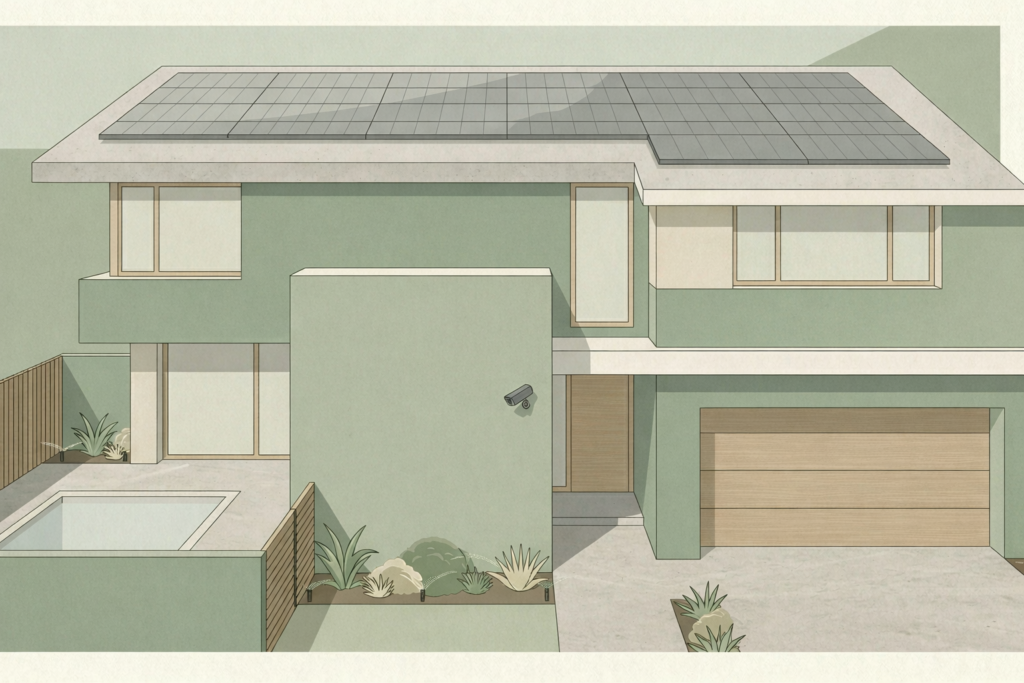
Most solar failures do not begin with incorrect equipment, but with unanswered or poorly answered questions before the contract is signed. The critical issue is not whether questions are asked, but whether the answers carry real clarity and accountability. When responses rely on generalizations, avoid measurable commitments, or shift responsibility elsewhere, the decision framework weakens early. Recognizing these patterns is not about confrontation, but about determining whether a real evaluation is taking place or a process is simply being pushed forward.

What defines expected production here?
Ask what exact annual energy production (kWh) assumption the offer is based on, and at what deviation the system counts as underperforming. This reveals whether performance is tied to a measurable threshold or left open to interpretation.
Red flag answers: “These numbers come from industry-standard software — they’re very accurate.”
What it means: The estimate likely relies on default assumptions about shading, weather, and system behavior that may not match your home. Underperformance can later be reframed as “normal variation,” rather than a correctable issue.

How was shading actually evaluated?
Ask which months, hours, and seasons were explicitly included in the shading analysis—and which were excluded. This exposes whether shading losses were assessed under real operating conditions or selectively modeled.
Red flag answers: “Shading is already factored in,” “The software accounts for everything.”
What it means: Critical time-based losses may be averaged or ignored. The system may appear balanced on paper but behave differently under real daily and seasonal patterns.

Where are system losses defined and owned?
Ask which losses are assumed as fixed, and which are treated as “acceptable variance.” This helps identify where uncertainty replaces accountability.
Red flag answers: “Some variation is normal,” “All systems have losses.”
What it means: Performance gaps may later be attributed to “normal behavior,” leaving no clear line between expected performance and correctable issues.

What is this system actually optimized for?
Ask whether the system is optimized for annual yield or peak conditions—and where that tradeoff is documented. This reveals hidden design priorities.
Red flag answers: “It’s optimized for overall performance,” “You’ll get the best of both.”
What it means: Tradeoffs are not being made explicit. The system may perform well in charts but underdeliver in real usage patterns.

Which decisions become irreversible after installation?
Ask which design choices at this stage cannot be changed later without major cost or rework. This identifies early lock-in points.
Red flag answers: “Everything is flexible,” “You can always adjust later.”
What it means: Irreversible decisions like layout, cabling, or inverter configuration are being downplayed. Future changes may be far more constrained than presented.

How will this system behave under real conditions?
Ask how the inverter behaves at high temperatures and voltage extremes typical for your site. This targets real-world stress conditions.
Red flag answers: “It operates within spec,” “These systems are very reliable.”
What it means: Edge-case performance is not being examined. The system may technically function while quietly losing efficiency in real conditions.

What limits future expansion or changes?
Ask which technical choices made now could make future expansion expensive or impossible. This surfaces long-term constraints.
Red flag answers: “You can always add more panels later.”
What it means: Expansion may be restricted by inverter capacity, electrical panel limits, or system design. Future flexibility is assumed, not guaranteed.

Where are compatibility risks acknowledged?
Ask what performance risks are introduced by panel–inverter matching, and where they are quantified. This forces acknowledgment of tradeoffs.
Red flag answers: “Everything is within normal limits,” “This setup is standard.”
What it means: Compatibility compromises are being minimized. These may later show up as reduced efficiency or uneven system behavior.

Who is responsible if performance drops?
Ask how responsibility will be separated between design, installation, and user behavior if production is lower than expected. This prevents blurred accountability.
Red flag answers: “If there’s a real issue, you can always call customer support.”
What it means: There is no clear ownership of outcomes. Issues may be delayed or shifted between parties without resolution.

What defines ‘normal’ performance over time?
Ask which measurable indicators will be used to determine whether the system is operating normally years from now. This sets a long-term baseline.
Red flag answers: “Degradation is normal,” “Performance changes over time.”
What it means: Without defined metrics, underperformance can be reinterpreted as expected aging rather than a problem.

How do grid rules affect your system?
Ask how grid conditions or curtailment will affect usable production and system accountability. This captures external constraints.
Red flag answers: “Utilities don’t really reject systems if they’re installed properly.”
What it means: Export limits, policy rules, or infrastructure constraints are being ignored. These can reduce usable output after installation.

What happens if timelines slip?
Ask who is responsible for securing Permission to Operate (PTO), and what happens if it is delayed. This clarifies process risk.
Red flag answers: “PTO is just paperwork — it usually takes a few weeks.”
What it means: The approval process depends on external parties. The system may be installed but unusable for months while costs continue.

What control do you actually have after installation?
Ask what monitoring access you will personally have, and who owns system data. This defines control.
Red flag answers: “We handle monitoring — you don’t need to worry about it.”
What it means: Access may be restricted or dependent on the installer. You may not be able to verify performance or detect issues independently.

What is not being discussed in this proposal?
Ask what is required for operation but not included in the offer. This reveals hidden scope gaps.
Red flag answers: “Everything you need is included.”
What it means: Additional work or costs may appear later as “out of scope,” increasing total project cost.

When should you not proceed?
Ask under what conditions the installer would recommend delaying or not moving forward. This tests objectivity.
Red flag answers: “Solar is always a good idea — sooner is better.”
What it means: There is no disqualification logic. The process is driven by selling, not by suitability.

What happens if expectations and reality diverge?
Ask what formal remedies exist if the system does not meet expectations. This defines your leverage.
Red flag answers: “We’ve never had a situation like that.”
What it means: Dispute resolution and accountability are undefined. Your options may only become clear after problems occur.

The Alice & Bob Story: Same System, Different Outcomes

Two similar homes can end up with completely different experiences, not because of the system itself, but because of how the decision was approached. The difference emerges in how uncertainty is handled. One path slows down to examine limits, while the other moves forward by trusting simplified explanations. The system behaves within its design in both cases, yet the lived experience diverges as unexamined assumptions surface over time.

Where questions change the direction
Alice did not jump into the idea of solar energy with blind excitement. Before even looking at the roof, she opened her notebook. Before asking how many panels were needed, she tried to understand how the system would actually live with the house. She did not interrupt the salesperson, but she added a small question to the end of almost every sentence.
“How does this inverter behave at high temperatures in the summer?”
“If one panel underperforms, does it affect the entire string?”
“If production drops, will I be able to tell whether it’s a fault or just system behavior?”
As the questions progressed, the atmosphere in the room shifted. The explanations slowed down, the answers became rounder. Phrases like “It usually doesn’t cause problems,” “This is more than enough for homes like yours,” and “If we get into details, things get complicated” started appearing more often. Alice took notes. Not of the answers themselves, but of how evasive they were.
The proposal was on the table, but Alice did not rush.
“Let’s think about it,” she said. “And let’s also talk about life after the installation.”

Where speed replaces understanding
Bob went through the same process much faster. He had researched too, but his research was limited to one basic question: does it work or not?
“Everyone’s doing it anyway,” he said. “This doesn’t need to be overcomplicated.”
When the salesperson started explaining inverter types, Bob cut in.
“They all end up doing the same thing,” he said.
When shading came up, he brushed it off. “Our roof is open, no trees.”
When system monitoring was mentioned, he smiled. “There’s an app. What more do you need?”
The contract was signed quickly. The installation went smoothly. Panels were mounted, cables were neatly routed, the app was installed. That evening, Bob stepped onto the balcony and looked up at the roof.
“All set,” he thought. The matter felt closed.

Where the system starts to feel different
In the first month, everything seemed fine. There was production, the electricity bill had dropped. But on some days, the graphs dipped earlier than expected. In the afternoon, while the sun was still high, the system behaved as if evening had already arrived.
At first, Bob didn’t worry.
“It’s probably the heat,” he said. “Or clouds.”
In the second month, the inverter threw two fault warnings. Short alerts appeared in the app, then disappeared. He called service.
“A reset usually fixes it,” they said. It seemed to fix it.
But Bob now checked the app several times a day. Because the system was working — but not working fully. And that difference, while subtle on paper, was very noticeable inside the house.

Where explanations arrive too late
By mid-summer, the picture became clear. At peak sunlight, the inverter was throttling output. When the air conditioner was running, the house was still pulling power from the grid even while the system was producing. On some days, afternoon production dropped nearly by half.
Service was called again. This time, the tone changed.
“This inverter tends to enter protection mode aggressively in hot climates.”
“For this roof angle, a different configuration might have been better.”
“The shading is minimal, but it may be creating a cascading effect.”
For the first time, Bob heard sentences that clearly belonged before installation. The shadow of the chimney fell on the corner of a single panel — and that shadow affected the entire string.
“Was this discussed during installation?” he asked. The answer was not clear.

Where responsibility becomes unclear
When the topic of warranty came up, things became even more tangled. Inverter issues were tied to “operating conditions,” panel losses to “environmental factors,” and production shortfalls to “performance expectations.” Everything had a justification — yet none of them fully matched what Bob was actually experiencing.
One evening in the kitchen, the air conditioner was running and the app was open again. There was production, yet the house was still drawing from the grid. Bob looked at the bill, then back at the graph. He stayed silent for a long moment.
Then, almost to himself — but sounding like a confession that came far too late — he said:
“I wish I had asked this at the beginning.”

Where the decision actually diverges
Months later, when Bob ran into Alice, he explained the system.
“It works, but not the way I expected,” he said.
Alice listened and nodded.
“That’s where I walked away from the table.”
It wasn’t a victory line. It wasn’t a warning either. It was simply the difference between questions asked at the right time — and questions asked too late.
Out in the field, no one remembered kilowatt-hours, payback charts, or amortization periods.
The only thing people remembered was always the same sentence:
“I wish I had asked this at the beginning.”

Decision Compass: What Actually Fits Your Life

The key shift is moving away from “How much will this system produce?” toward “What will it demand from me over time?” When this question is ignored, systems are evaluated on output rather than fit. Solar systems rarely fail because they cannot generate energy, but because their operation does not align with the homeowner’s expectations, habits, or tolerance for involvement. Clarity at this stage does not simplify the decision, but reveals whether the system belongs in the first place.

When the decision stops being technical
Throughout this dossier, many elements specific to residential solar PV systems have been laid out. What to ask before receiving a quote, how production figures are framed under ideal assumptions, which technical explanations quietly rely on grid stability, inverter behavior, or user intervention, and which post-installation situations are normalized in sales language but become visible only after the system is live. None of these elements were presented to push toward a single conclusion. Because in the real world, decisions about rooftop solar are never made on a single technical promise.
For most homeowners, the decision seems to be finalized when the panel brand is selected or the contract is signed. Field experience shows otherwise. With residential PV systems, the decision is revisited many times: when the first monthly production report arrives, when cloud cover causes unexpected drops, when the inverter issues its first alert, when the utility bill does not fall as smoothly as expected, or when seasonal differences make summer and winter feel like two different systems.

When the real question becomes visible
That is why the core question here is not “Which solar system should I buy?” The real question is: Can this specific rooftop PV system settle into my daily life without constantly demanding my attention? Earlier sections covered familiar promises such as annual kWh production, payback period calculations, and self-consumption ratios. In the field, however, dissatisfaction rarely stemmed from total production alone. It came from the space between what homeowners thought “normal operation” meant and what living with a solar PV system actually required.

Inverter shutdowns described as “temporary,” monitoring apps that needed regular checking, grid outages that silently reduced export, and contract clauses that limited future system changes all contributed to this gap. Many aspects that were technically acceptable became mentally intrusive over time, shifting the decision away from system efficiency and toward personal tolerance.

When expectations meet daily reality
Monitoring production turned into habit. Comparing forecasts to real output became routine. Questions like “Is this drop seasonal or a fault?” entered daily thinking. At that point, the system was no longer just equipment on the roof—it became part of everyday attention. In residential PV installations, this tolerance threshold varied widely. Some homeowners were comfortable tracking inverter data and understanding grid behavior. Others expected electricity to return to being invisible after installation.

For the latter group, even a perfectly functioning system created friction. Field observations repeatedly showed that dissatisfaction was often traced not to poor equipment, but to a mismatch between operational reality and expectations.

When the decision becomes personal
This is where the decision shifts. If everything described felt manageable—monitoring production, accepting seasonal variability, coordinating with service providers, understanding grid dependency—that is a meaningful signal. But if certain topics repeatedly triggered hesitation—reliance on a single inverter, uncertainty during cloudy weeks, limited service response, long contractual commitments, or changing household usage—that signal matters just as much.

In many cases, homeowners later realized they sensed this discomfort long before any technical issue appeared. Residential solar decisions often begin with “Will it lower my electricity bill?” but those that remain satisfying tend to hinge on a different question: “Am I comfortable living with how this system behaves day after day?”

When time reshapes the meaning of the system
Most decisions are made based on present-day conditions—current consumption, tariffs, and incentives. Yet in real installations, the weight of the decision unfolds over years. Panel degradation, inverter replacement timelines, maintenance needs, changes in household size, electric vehicle adoption, or selling the home all reshape the system’s role. What seemed like minor technical details at the quote stage gradually move to the center of daily experience.

From this point onward, the decision is no longer about comparing panel efficiencies or inverter brands. It becomes a personal choice between autonomy and grid dependence, between financial optimization and mental simplicity, between theoretical savings and lived experience.

When “technically correct” is not enough
One common misconception observed in the field is that choosing the technically best system guarantees the right decision. In many cases, systems were well designed, properly installed, and performed within expected ranges. Yet the decision still felt wrong for the homeowner. Because a technically correct PV system does not automatically translate into a comfortable daily reality.
The right decision was defined not by performance graphs, but by whether living with that performance felt acceptable. This is the distinction that becomes visible only over time.

Where the real boundary appears
If, after reading this dossier, what kind of solar setup you want has become clearer, this compass has served its purpose. If what you do not want has become unmistakably clear, it has served its purpose as well. For a significant number of homeowners, the healthiest outcome was choosing not to proceed—stepping back at the quotation stage or postponing installation. These were not missed opportunities; they were boundaries recognized in time.

Because the most common regret in residential solar was not choosing the wrong equipment. It was realizing personal limits too late. This compass does not tell you to install solar. It clarifies what living with a residential PV system actually asks of you—before the roof is drilled and the inverter goes live.

Final Transparency: No Recommendation By Design

The absence of a recommendation is intentional. Any suggestion made without understanding the specific home, usage patterns, and risk tolerance would replace the buyer’s priorities with a generic conclusion. Solar systems do not produce uniform outcomes across different contexts. The purpose here is not to decide, but to prevent the decision from being shaped by incomplete assumptions. The final choice remains with the person who will live with its long-term consequences.

Why no products or rankings are shown
This file was not written to answer the question “Which brand should I buy?” for residential solar energy systems. No brand recommendations are made here, no product rankings are presented, and no purchase links or promotional redirects are included. This approach is not a claim of neutrality; it is an editorial decision made out of necessity, driven by the nature of residential solar itself.
Residential PV systems are not products that can be meaningfully selected by comparing catalog specifications alone. The same panel model, the same inverter, or the same installation promise can produce entirely different outcomes depending on roof geometry, household consumption patterns, grid conditions, and user expectations. For this reason, this file deliberately rejects generalized answers such as “the best system” or “the most sensible package.”

Why simplified numbers are not used to close decisions
This page does not include ROI tables, payback timelines, or single-number summaries designed to close a decision. That choice does not imply that numbers are unimportant. It reflects the reality that, in residential solar, most numbers depend on assumptions—and those assumptions rarely hold the same way for every home.

Rather than polishing projections, this file focuses on showing when and why those numbers lose their meaning. What looks precise in a calculation can become uncertain in real conditions, especially when production, usage, and external factors begin to interact over time.

Why the focus is on decision fragility, not persuasion
What is presented here is not intended to promote or discredit any specific system. Its purpose is to make visible the points at which residential solar decisions become fragile: where expectations break down, where promises quietly shift, and where underlying assumptions fail.
The reader is not told “this is what you should buy,” but rather, “these are the questions you must be certain you can answer before you buy anything.” The emphasis is placed on understanding, not persuasion.

Why the decision is not made for you
This file does not make the final decision on behalf of the reader. In residential solar, the cost of a poor decision is not something an editorial platform can absorb. That cost is lived with at home, reflected in monthly bills, and felt over years of system operation.
For this reason, the goal of this page is not to take responsibility for the decision, but to raise the quality of the decision-making process itself.

What you should leave with instead
The reader should leave this page not with a shopping list, but with a clearer understanding of which options do not align with their home, their consumption habits, their budget, or their personal risk threshold.

Everything this file does—and deliberately does not do—exists to make that distinction unmistakably clear.

What most homeowners realize too late

“You can add more panels later” is often a theoretical statement. Many residential systems are designed in a way that does not allow even a small future expansion. When the need for additional panels arises, the issue is not the panels themselves, but inverter inputs, string balance, or electrical panel capacity.

DC cabling is invisible, but it is one of the most irreversible decisions in the system. Cable cross-sections and routing are often kept to the minimum. The system works; but when an inverter replacement or system expansion becomes necessary, these early decisions quietly turn into added costs.
